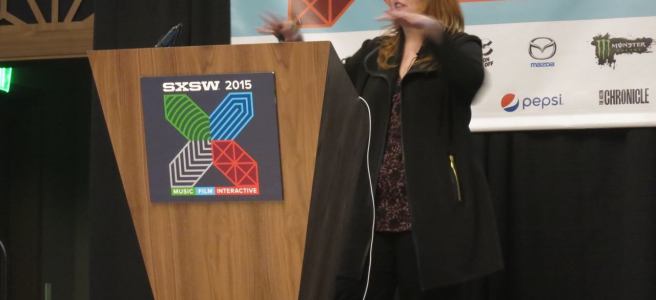
I spent my “Pi Day of the Century” in Austin, Texas at the South by Southwest® Interactive Festival.* It was my first time speaking at SXSW — and my first time attending! My talk was “Consumer Data: the Good, the Bad, the Not-So-Ugly.”
The discussion started with defining what it means to be a designer. As a designer, we are advocates for the consumer and empathize deeply with them. It is our job to delicately balance the needs of the consumer, the needs of the business, and technical constraints, with the goal of creating an innovative product or feature. We must share our designs early and often, with users, stakeholders, executives, and partners. We are the shepherds of the design along its journey, with the purpose of releasing a wonderful user experience.
I then covered the historical use of data in design: to educate designers. Designers have long relied on quantitative data (surveys), qualitative data (ethnography, usability studies), clicks and click paths, and A/B tests, to give designers measurable feedback on their designs — which, in turn, makes them better designers.
But now, data is becoming a core element of the products themselves. There are apps built around location data. Products and services that make recommendations for new things you might want, based on data on what you’ve liked before. There are apps that help you organize your own thoughts and ideas (what to read, what to buy, what to watch, what to do). There are products that track your progress (exercising, losing weight, staying on budget, learning a new skill).
There are also products that change based on data. Smart locks connected to a smart thermostat can know that someone has arrived home and can adjust the temperature accordingly. Wearables can wake you up in a light sleep cycle close to your wakeup time, or make sure you move around if you’ve been sitting too long.
Data is often a “side effect” of great products or services — meaning that it isn’t what customers think about when they buy the product. Your car collects a lot of information about your driving (speed, braking, location). The location data attached to tweets and posts allow others to see what people are doing and talking about in different parts of the world. Data aggregated across many users (such as food-tracking apps) can give us insights into the way humans behave.
Products are becoming smarter and using data to improve individual user experiences. Here I make a distinction between “customization”, which I define as changes to the experience based on the user’s settings; and “personalization”, which I define as changes to the experience based on the user’s behavior. These changes can be as simple as remembering the last game you played, or show you watched, or setting you used — and making it easy to get back there quickly. Or the product could remember the options you are most likely to choose: display an option for the amount you most frequently withdraw from the ATM, in addition to the standard options; learn that you choose a very different route between your home and the freeway from the one the GPS always suggests, and start suggesting that alternate route instead; make auto-suggestions upon text entry based on the words you frequently use.
The next wave of using customer data is in predicting what you are going to do next, and surfacing information that is most relevant to you in a timely way. I’m pretty sure I can figure out what you are likely to watch on TV tonight, based on your past viewing behavior.
But there is a fine line between “smart” and “creepy” when it comes to using consumer data. No one wants to feel watched. People do want products to feel effortless. We need to make sure we are using consumer data for consumer benefit, and providing valuable features and experiences. As designers, we need to continue to be the advocates for our customers, and ask questions such as: “What happens if others get this data?” and “How long do we need to keep this data?” In all of the things we need to balance, we also need to consider privacy and security. In our drive to create an innovative product, we also need to create a responsible product. And as product creators, most of all we need to dream. This is an exciting time — there are many rewarding experiences we can create with access to so much consumer data. This is also a scary time — never has more information been known about us as individuals and as groups.
The questions from the audience were great — they were engaged designers clearly thinking about the experiences they could create. I left the event energized that a great group of people had come together in Austin to consider how to make a better future for all of us.
* SXSW and ‘South by Southwest’ are registered trademarks of SXSW, LLC. TiVo is not an affiliate of SXSW, LLC and is not a sponsor of any SXSW festivals or conferences. SXSW, LLC does not endorse any TiVo products, services, or promotional activities.

 tivoinfodraft.data.blog